
You mention mattresses to your spouse. Later that day, Instagram shows you a mattress advertisement. You pause on one video about burnout, and within a week your Reels feed appears to understand your work situation better than your friends do. You watch a few running videos “just out of curiosity,” and the platform begins serving marathon plans, electrolyte advice, injury-prevention content, and advertisements for carbon-plated shoes.
The immediate conclusion is usually: Meta must be listening.
That conclusion is not established by the anecdote. The more technically plausible explanation is also more revealing: Meta’s systems often do not need to hear the sentence you spoke. They can make useful predictions from the timing and order of your behavior, the content you pause on, the accounts and people around you, the websites and advertisers you interact with, and the behavior of millions of people whose patterns partially resemble yours.
The system does not need to understand your inner life. It only needs to estimate what you are likely to do next.
There Is No Single “Meta Algorithm”
Meta publicly describes Facebook and Instagram as being powered by many AI systems, not one master algorithm. Each system can contain multiple models that identify candidate content and predict whether a particular person is likely to watch, click, like, share, hide, or otherwise respond. Meta says thousands of signals are used across its services, including views, watch duration, engagement with similar content, and prior interaction with an author.[1]
This distinction matters. The feed is not built by a simple rule such as:
You clicked on running content, so show more running content.
A more accurate conceptual model is:
Given this user, this item, this moment, this device context, this behavioral history, and the available alternatives, what outcomes are most probable—and which combination of outcomes best advances the system’s objectives?
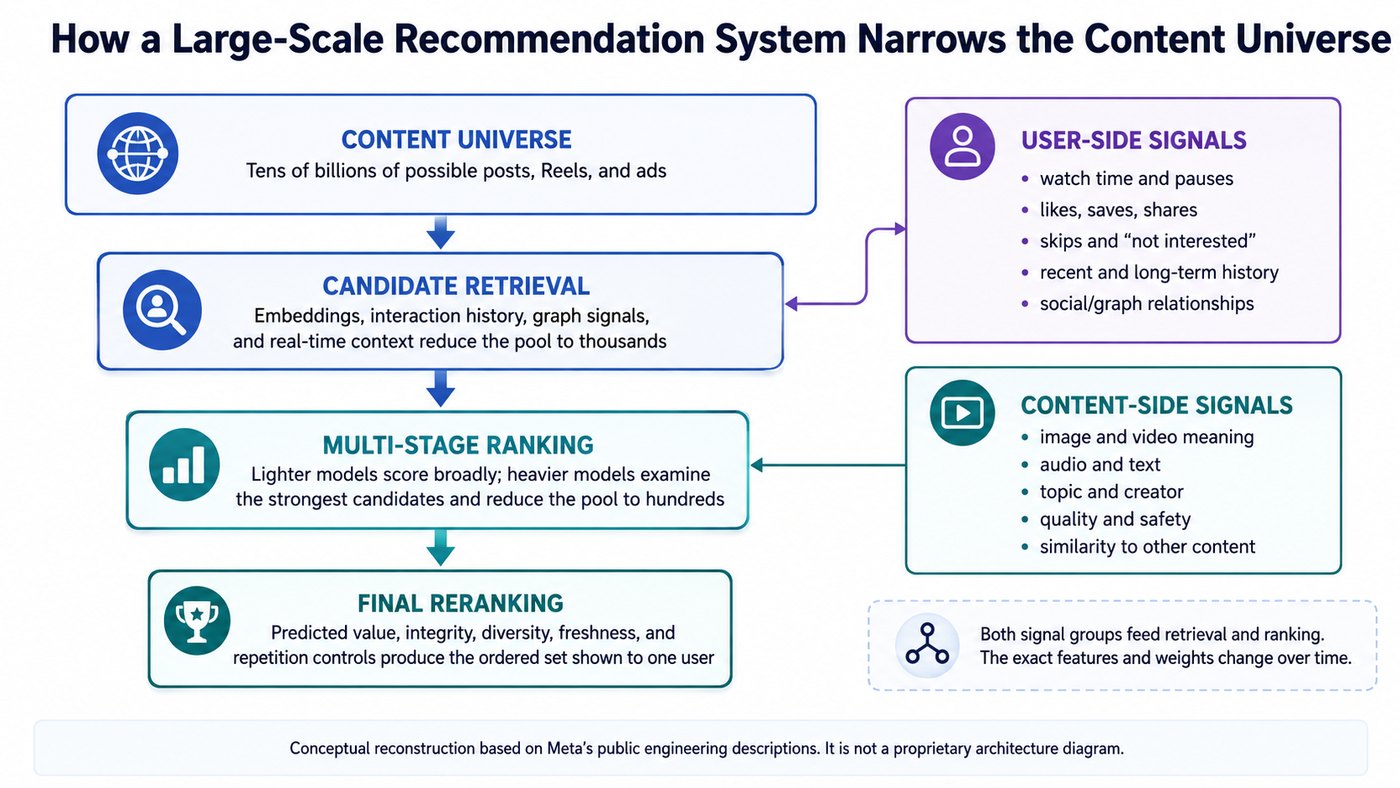
Figure 1. Conceptual reconstruction from Meta’s public engineering descriptions; not a proprietary Meta diagram.
1. It Can Reduce Tens of Billions of Possibilities in Real Time
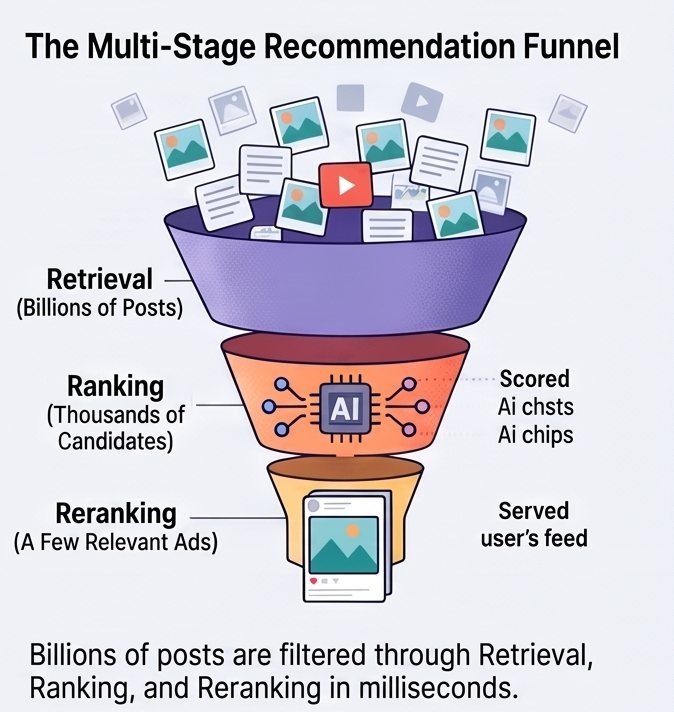
Meta says its discovery systems may begin with tens of billions of pieces of content. Retrieval systems narrow that universe to thousands of plausible candidates in hundredths of a second, then ranking systems reduce the pool to hundreds before a final set is ordered for the user.[2]
Instagram Explore uses a multi-stage funnel that includes retrieval, first-stage ranking, second-stage ranking, and final reranking. Meta has described lightweight models screening large candidate pools before heavier models analyze the strongest candidates using richer user–item interaction features.[3]
The ranking objective is not merely “probability of a click.” A simplified version of the value calculation described by Meta can be written as:
where:
- (u) is the user;
- (i) is the candidate item;
- (c) is the current context;
- each (P(\cdot)) is a predicted probability;
- each (w) expresses how strongly the system values that outcome.
This equation explains why two people can receive different feeds after watching the same video. The relevant prediction is not “Is this a good video?” It is “What is the expected value of showing this video to this person now, relative to every competing candidate?”
Final reranking can also account for integrity, diversity, repetition, freshness, creator balance, and other controls. A system may therefore suppress the highest raw engagement prediction because the feed has already shown too much from one creator or topic.
2. Your Hesitation Can Be More Informative Than Your Like
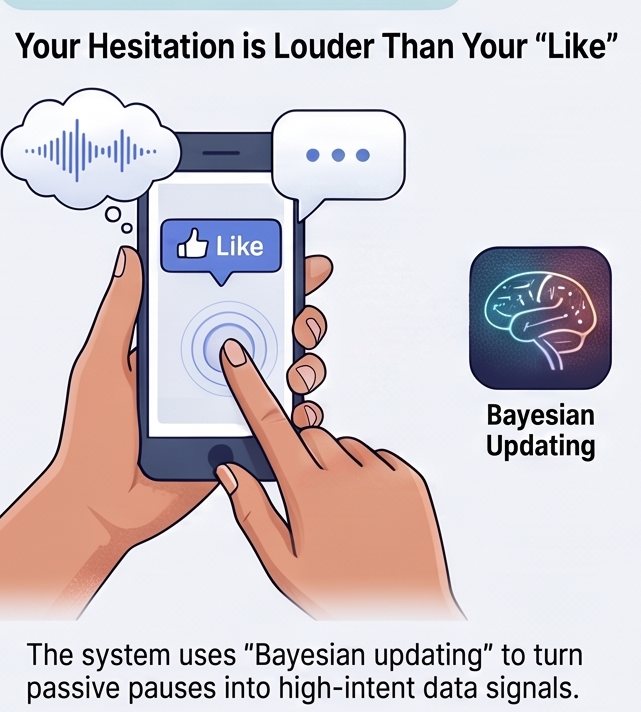
Users tend to think only deliberate actions count: searches, likes, comments, follows, saves, and purchases. Meta’s published material says watch duration and short views also influence recommendations. Watching an entire video can be treated as positive feedback; stopping after only a few seconds can indicate disinterest.[1][2]
The system can also compare an action against your own baseline. A twelve-second pause may mean little for someone who watches everything slowly. It may be highly informative for someone who normally swipes in under one second.
A useful way to understand this is Bayesian updating. Suppose I means “this topic is currently relevant to the user,” and B is newly observed behavior. Then:
The first fraction on the right is the prior odds that the topic matters. The second is a likelihood ratio: how much more likely the behavior would be if the interest were real than if it were not. Several modest signals can multiply into a large change in the model’s belief.
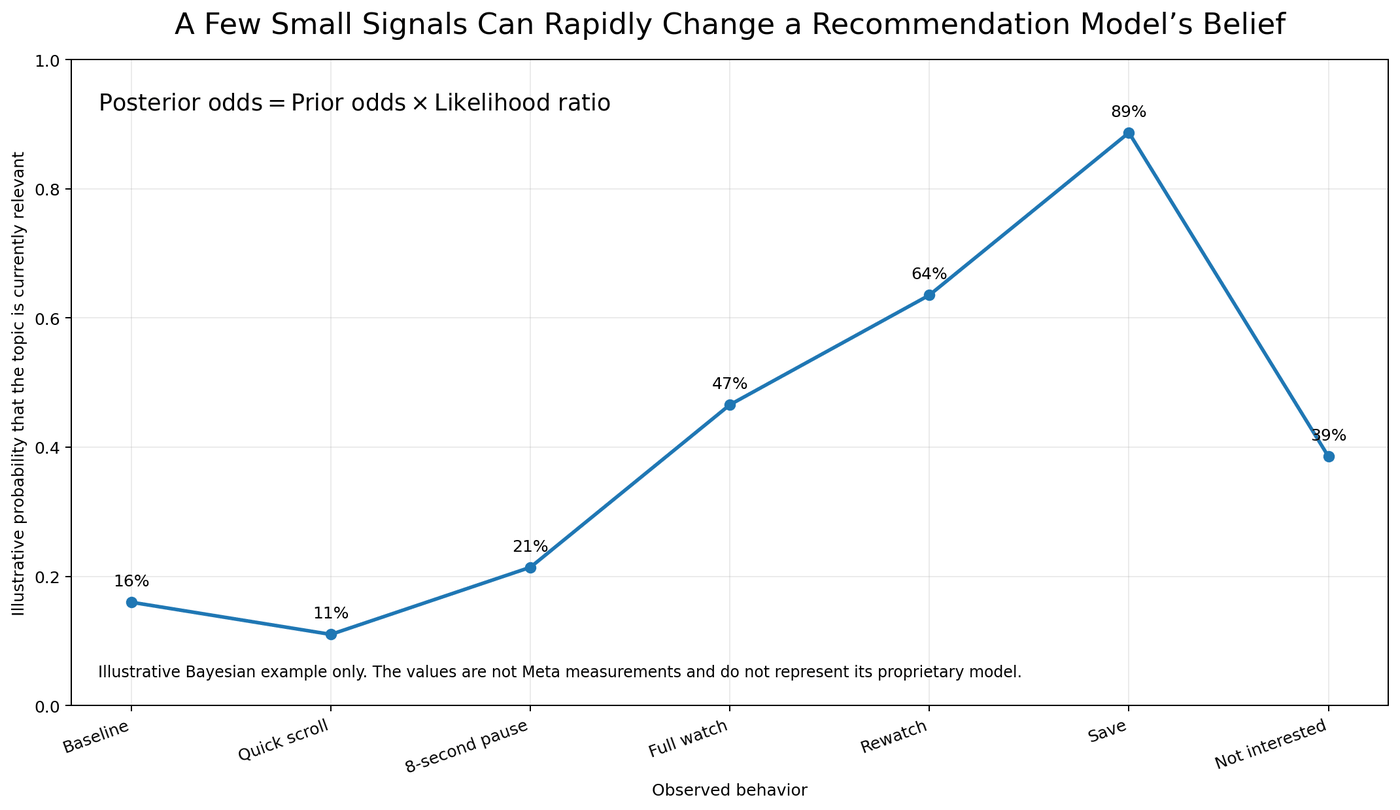
Figure 2. Illustrative Bayesian example. The values are not Meta data and do not represent Meta’s proprietary model.
This makes a common anecdote technically plausible:
“I did not like or search for anything. I only paused on one video, and suddenly my entire feed changed.”
The feed probably did not permanently classify the user after one pause. More likely, it increased the probability of the topic, tested several nearby candidates, received additional behavioral feedback, and then either expanded or abandoned the hypothesis.
3. It Can Recommend What You Never Explicitly Requested
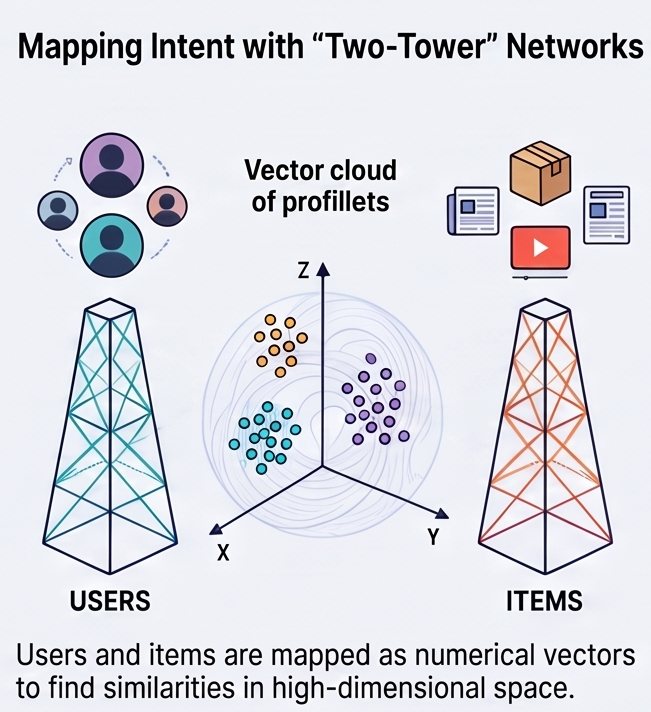
Meta has described “two-tower” neural networks that encode a user and a piece of content into numerical vectors called embeddings. Relevant users and items are trained to occupy nearby regions of a high-dimensional space.[3]
A simplified similarity measure is cosine similarity:
where (\mathbf z_u) is the user embedding and (\mathbf z_i) is the item embedding. The larger the similarity, the stronger the candidate match.
A retrieval probability can then be conceptualized with a softmax function:
Here, C is the candidate set and τ controls how sharply the model favors the closest matches.
The practical consequence is important: the platform can recommend an interest you have never named. It does not need a rule saying, “People who like mountain biking also like trail mix.” It can learn that relationship from patterns in the embedding and interaction data. Meta itself uses a similar example: someone interested in mountain biking might be shown trail-mix recipes that other mountain-biking enthusiasts valued.[2]
This is one reason recommendations can feel creative rather than repetitive. The model is not only retrieving copies of what you consumed. It is navigating a learned map of relationships among people, creators, topics, formats, and behaviors.
4. The Order of Your Actions Changes Their Meaning
A static recommendation model might treat history as a bag of interests: Italy, hotels, architecture, weddings. A sequence model asks what happened first, what followed, how much time passed, and which candidate is being evaluated now.
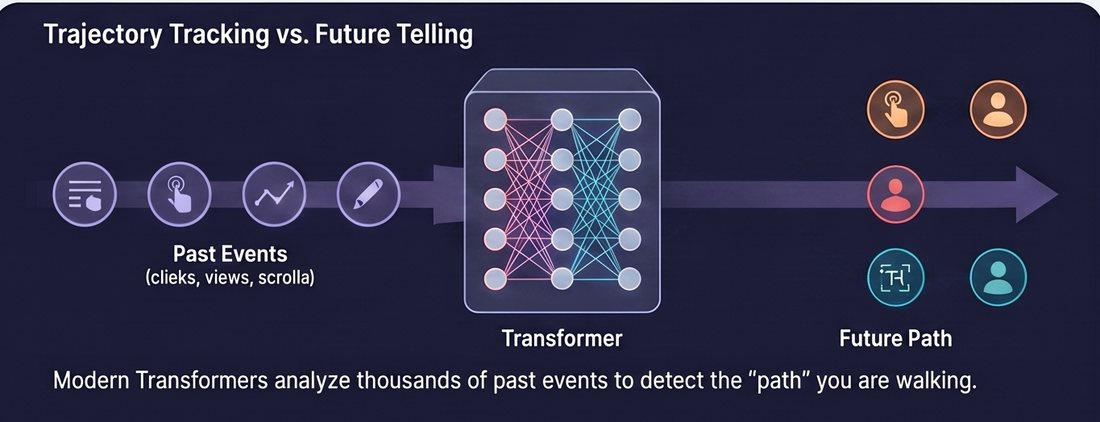
Meta reported in August 2026 that its advertising recommendation architecture models the order and timing of user actions and can build representations from thousands of user events, including views, clicks, and purchases. It also uses target-aware attention so that the relevance of past behavior is assessed against the specific advertisement being scored.[4]
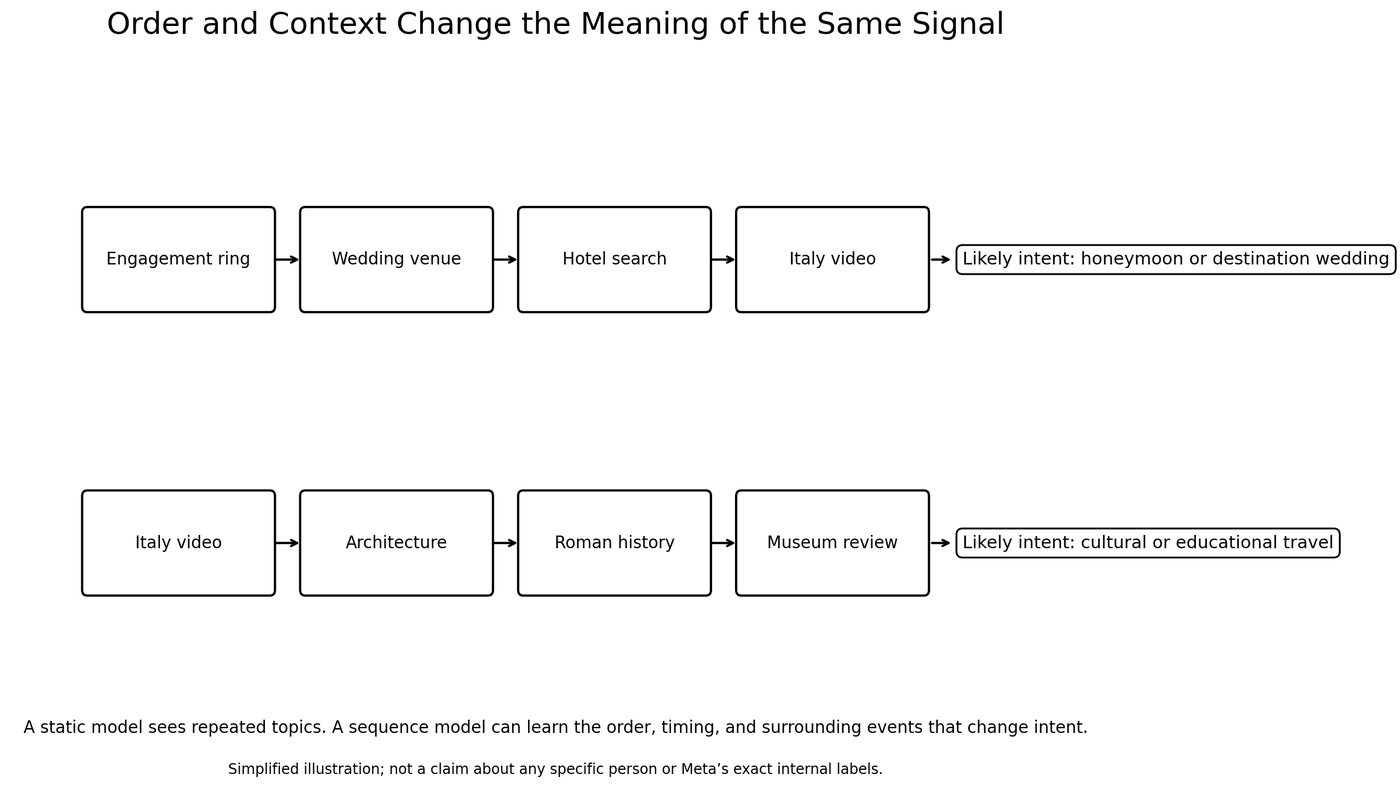
Figure 3. Simplified illustration of sequence-aware modeling; not Meta’s exact internal labeling system.
A simplified sequence model can be written as:
where:
- (T) is a transformer or other sequence encoder;
- (\mathbf e_1,\ldots,\mathbf e_t) are ordered behavioral events;
- (\mathbf h_t) is the resulting representation of the user’s current state;
- (H_t) is the event history;
- (a) is a possible action, such as clicking or purchasing;
- (\sigma) converts the score into a probability.
Meta says these sequence-modeling improvements contributed to cumulative gains of 6% in Instagram ad conversions, 3% in Facebook ad conversions, and 3.5% in Facebook ad clicks. Those are company-reported production results, not independent audits, and they apply to Meta’s advertising system rather than every feed surface.[4]
The underlying capability nevertheless explains another widely reported experience:
“The algorithm seemed to know what I was becoming interested in before I consciously decided.”
A user may describe several weeks of behavior as casual exploration. A sequence model may recognize that the pattern resembles the early stages of a durable interest: running content becomes training plans, training plans become shoe research, shoe research becomes race registration. The model does not foresee the future in a mystical sense. It detects that the current trajectory resembles trajectories that previously led to a predictable next step.
5. Weak Signals Can Reveal Attributes You Never Stated
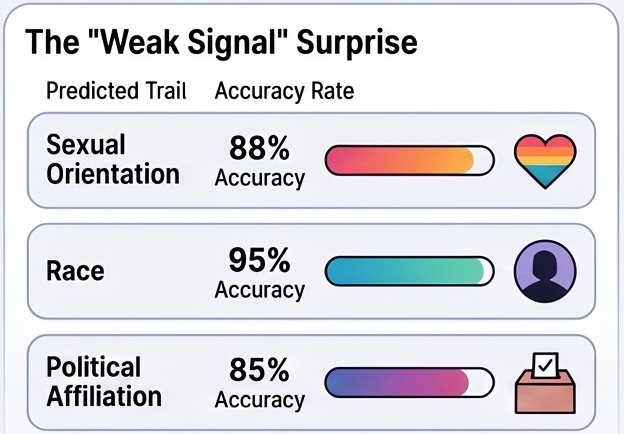
Independent research demonstrated this long before today’s much larger models existed.
A 2013 study published in the Proceedings of the National Academy of Sciences analyzed Facebook Likes from more than 58,000 volunteers. Using dimensionality reduction and regression, researchers predicted a range of personal attributes. In that dataset, the models distinguished homosexual from heterosexual men in 88% of cases, African American from Caucasian American users in 95% of cases, and Democrats from Republicans in 85% of cases.[7]
These results should be interpreted carefully. They came from a historical volunteer sample, measured particular categories, and do not prove that Meta currently makes or uses every such inference. They do establish a broader technical point: high-dimensional behavior can reveal information that is not explicitly disclosed.
The surprising part is that the individual signals do not have to make intuitive sense. A single Like may be nearly meaningless. Thousands of correlations across millions of people can make a pattern predictive. Machine learning can exploit combinations too weak, numerous, or counterintuitive for a human analyst to notice.
6. Meta’s Recommendation Models Now Operate at LLM-Like Scale
The strongest evidence of technical advancement is not an anecdote. It is the scale Meta publicly reports.
Meta says its Generative Ads Recommendation Model, or GEM, is the central foundation model behind advertising recommendations across Facebook and Instagram. GEM contains trillions of sparse embedding parameters and billions of dense parameters and trains on several thousand current-generation GPUs.[5]
Meta has also described an adaptive runtime ranking system with parameter scale on the order of one trillion, bounded latency on the order of 100 milliseconds, and model complexity comparable in some respects to large language model inference.[6]
Those numbers require context. A trillion sparse recommendation parameters are not directly equivalent to a trillion dense language-model parameters. Much of the parameter count can consist of enormous embedding tables that represent users, ads, creators, categories, and other entities. Parameter count alone does not establish intelligence.
What it does establish is that recommendation is no longer a lightweight sidebar function. It is a major AI workload involving transformers, attention mechanisms, graph models, multimodal content understanding, online learning, approximate nearest-neighbor search, large-scale experimentation, specialized GPU kernels, and extensive hardware–software co-design.[2][4][5][6]
7. Why the “We Only Talked About It” Anecdote Feels Convincing
The mattress story remains powerful because the sequence appears obvious:
- A private conversation occurs.
- A matching advertisement appears.
- The conversation must have caused the advertisement.
But several other causal structures can produce the same experience.
Prior behavior caused both events
You or someone close to you may already have been browsing homes, reading moving content, visiting furniture sites, or interacting with related material. Those circumstances made both the mattress conversation and the advertisement more likely.
Someone in your network supplied a related signal
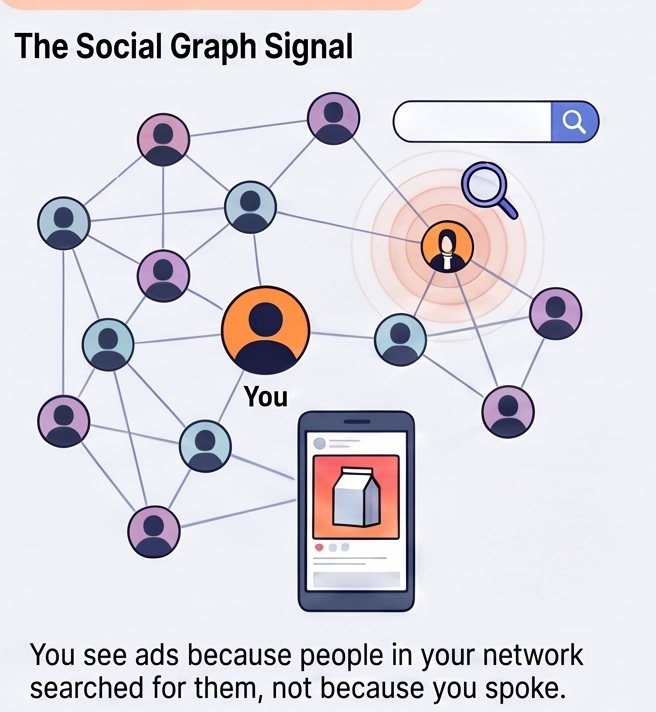
Meta’s systems can use social and graph relationships, while advertisers can provide activity data from their own sites and customer systems. The other person in the conversation may have searched for the product before mentioning it.
You saw the advertisement before you remember seeing it
Users process large quantities of feed content with limited conscious attention. An earlier impression may influence a later conversation without forming a durable memory. The subsequent ad then feels like a response to the conversation, even though the causal direction may be partly reversed.
Coincidence is amplified by selective memory
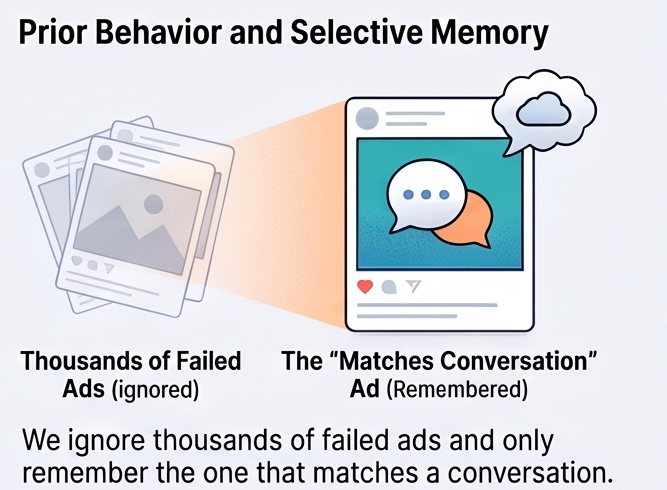
People have thousands of conversations and see thousands of commercial messages. Non-matches are ignored. A striking match is remembered and retold.
Meta has repeatedly denied using phone microphones to target advertisements. In 2025, Instagram head Adam Mosseri again denied the claim and cited prior browsing, friends’ or similar users’ activity, earlier unnoticed ad exposure, and coincidence as alternative explanations.[8] A company denial is not independent proof, but the conversation-to-ad anecdote by itself is also not evidence of microphone use.
The deeper point is that microphone surveillance is often unnecessary. A system with enough behavioral, social, contextual, and commercial data can sometimes predict the subject of a conversation before the conversation occurs.
8. Advanced Does Not Mean Omniscient
Recommendation models still fail in predictable ways:
- Engagement is not preference. People watch material because they are angry, shocked, confused, or worried.
- A shared device can create a false profile. One household member’s activity can contaminate another person’s recommendations.
- Life changes break historical patterns. A move, divorce, new job, illness, or new relationship can make months of prior data temporarily misleading.
- Feedback loops can exaggerate weak interests. The system tests a topic, the user watches because it is present, and the system interprets that exposure-driven behavior as stronger interest.
- Optimizing a measurable action is not the same as improving a person’s life. A model may predict watch time accurately while misunderstanding whether the user values the time spent.
A high probability is not certainty. A sophisticated representation is not consciousness. Prediction is not comprehension.
The Correct Mental Model
The most accurate way to think about Meta’s recommendation system is not as a person reading a secret biography about you. It is closer to a continuously changing mathematical representation:
Every new action changes that representation slightly. Every candidate is tested against it. The system then places a probabilistic bet about what you will do next.
That is why it can seem to know what you are thinking even when it does not. It does not need to recover the thought itself. It only needs enough correlated evidence to predict the behavior that usually follows.
The unsettling capability is not mind reading. It is prediction without understanding.
Source Notes
- Meta AI, “Introducing 22 System Cards That Explain How AI Powers Experiences on Facebook and Instagram,” June 29, 2023.
- Meta AI, “The AI Behind Unconnected Content Recommendations on Facebook and Instagram,” June 29, 2023.
- Engineering at Meta, “Scaling the Instagram Explore Recommendations System,” August 9, 2023.
- Engineering at Meta, “From User Sequences to Scaling Laws: A Multi-Stage Architecture for Meta’s Ads Ranking,” August 5, 2026.
- Engineering at Meta, “GEM Training: How Meta Doubled the Efficiency of Its LLM-Scale Ads Foundation Model,” August 3, 2026.
- Engineering at Meta, “Meta Adaptive Ranking Model: Bending the Inference Scaling Curve to Serve LLM-Scale Models for Ads,” March 31, 2026.
- Michal Kosinski, David Stillwell, and Thore Graepel, “Private Traits and Attributes Are Predictable from Digital Records of Human Behavior,” PNAS 110, no. 15 (2013): 5802–5805. DOI: 10.1073/pnas.1218772110.
- The Verge, “Adam Mosseri’s ‘We’re Totally Not Spying on You’ Video Is Raising a Lot of Questions,” October 1, 2025.